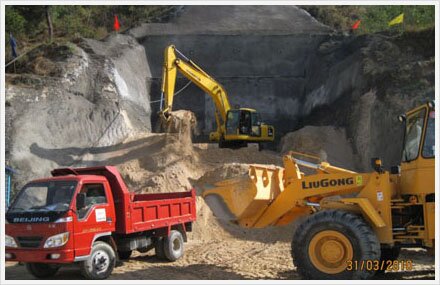
 The Melamchi Water Supply Project (MWSP) is considered to be the most viable long-term alternative to ease the chronic water shortage situation within the Kathmandu Valley. The Project is designed to divert about 170 MLD of fresh water to Kathmandu Valley from the Melamchi River in Sindhupalchowk district. Augmenting this supply by adding about a further 170 MLD each from the Yangri and Larke rivers, which lie in the upstream proximity of Melamchi are also being investigated as future supply sources. The Melamchi Water Supply Project (MWSP) is considered to be the most viable long-term alternative to ease the chronic water shortage situation within the Kathmandu Valley. The Project is designed to divert about 170 MLD of fresh water to Kathmandu Valley from the Melamchi River in Sindhupalchowk district. Augmenting this supply by adding about a further 170 MLD each from the Yangri and Larke rivers, which lie in the upstream proximity of Melamchi are also being investigated as future supply sources.
Ministry of Physical Planning and Works (MPPW) is the executing agency for the Project and an autonomous Melamchi Water Supply Development Board, formulated for Project implementation, is the implementing agency.
The Board, as an independent project implementing body has come a long way to collect the necessary funds to implement the project since 1998. The major donor of the project, Asian Development Bank (ADB) approved a Loan 1820-NEP (SF) on 21st December, 2000 and it was effective from 28th November, 2001. After six years of project implementation, Government of Nepal and the project's funding partners, felt necessicity to change the scopes of project implementation arrangement by splitting the MWSP into the following two distinct sub-projects in 2007;
(i) the Melamchi River Water Diversion Subproject (Sub-Project -1) covering all project activities in Melamchi Valley including constructions of Water Diversion Tunnel (WDT) and Water Treatment Plant (WTP) at Sundarijal and
(ii) Kathmandu Valley Water Supply and Sanitation Subproject (Subproject -2) comprising water distribution activities in Kathmandu Valley. EMP implementation requirements as per EIA and EMP of MWSP, 2000 and 2001 have been covered both of these sub-projects.
The MWSP originally comprised four parts:
| i) |
infrastructure development; |
| ii) |
social and environmental support; |
| iii) |
institutional reforms; and |
| iv) |
project implementation support. |
A complementary Kathmandu Valley Water Services Sector Development Program (SDP), has also been effective from December 2004 to support reforms and institutional development in the water services sector engaging private sector participation (PSP).
Various factors including political events during the past 6 years of MWSP and 3 years of SDP implementation did not make it possible to complete the project as planned. The withdrawal of the three co-financing development partners for the Project - the World Bank, NORAD, and SIDA resulted in a shortfall of $133 million in the originally projected cost of US$ 464 million as priced in 2000 AD.
ADB approved the proposed project restructuring, mainly reflecting the abovementioned financial and institutional changes made during its 6 years of implementation and proposing the removal of identified obstacles in implementation, in February 2008. After the restructuring, the Project has now been revised to a total of $317.3 million and a completion date of June 2013. The cost will be jointly funded by several agencies such as: ADB (Loan 1820-NEP) - $137 m, JBIC - $ 47.5 m, JICA - $18 m, NDF - $10.5 m, OPEC - $13.7 m, and GoN - $ 90.6 million.
Out of US$317.3 million Subproject I ,Melamchi Water Supply Project (MWSP) will be utilizing US$ 249.4 million with following contribution of different donors ADB - US$ 103.8 m 41.62%, JBIC(JICA) – US$47.5 m 19%, NDF- US$- 10.5 m 4.2%, OPEC- US$ 13.7m 5.5% and GoN US$73.9 m (29.63%)
The revised Project comprises three components: Part A. Melamchi Valley Subproject (Subproject I), Part B. Kathmandu Valley Subproject (Subproject II), and Part C. Project Support (Subproject III) as described below:
Part A. Subproject I Comprises:
 |
Construction of Melamchi Diversion Scheme to carry out about 170 MLD of raw water from the Melamchi River into Kathmandu Valley through a 26.5 km tunnel;
|
|
Construction of about 43 km of access roads and upgrading of about 29 km of road to assist the construction of the Project facilities and their maintenance;
|
|
Construction of a water treatment plant with an initial capacity of at least 170 MLD and expandable to about 510 MLD to treat the Melamchi River Water; and
|
|
Development and implementation of a social upliftment program, including - a) buffer zone development, b) rural electrification, c) health, d) education, and e) income generation/community development. |
Part B. Subproject II Comprises:
|
Rehabilitation and improvement of distribution networks at primary, secondary, and tertiary levels, house connections, rehabilitation and improvement of existing water supply system including intakes, transmission lines, water treatment plants and service reservoirs;
|
|
Construction of a bulk distribution system comprising service reservoirs strategically located in the Kathmandu Valley and bulk water supply pipelines leading to the reservoirs from the water treatment plant in the pipeline and will be constructed once the fund is available;
|
|
Undertaking the improvements of waste water system in a phased manner; and
|
|
Development of a shallow ground water well field at Manohara within the Kathmandu Valley to extract, treat, and distribute about 20 MLD of water in Kathmandu valley. |
Part C. Subproject III Comprises:
|
Development and implementation of i) a resettlement action plan; and ii) an Environmental Management Plan (EMP) to mitigate direct and indirect Project impacts, including a) hygiene education, b) public relations programs, c) (if required by ADB) a social and environmental monitoring program undertake by a panel of domestic experts, and d) a groundwater monitoring program; and
|
|
Provision of support to carry out various Project administration activities, including PMU operations, design and construction supervision, social and environmental activities and training provision of incremental administration and operation costs. |
|