|
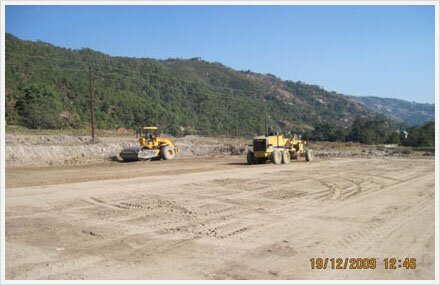
The water treatment plant will treat raw water coming through 26.5 Km tunnel from Melamchi River for the Melamchi water supply project. The ultimate capacity of the water treatment plant will be 510 mld. The plant will be developed in three phases, each of 170 Ml/d.
The second stage will be accomplished by duplicating the major facilities of the initial phase, and the third phase will comprise mainly performance enhancements and increased design loading on the facilities constructed under phases 1 and 2.
As the first phase of WTP project, the detailed design of the WTP capacity will be done for 170 mld with provision of the future expansion. The design of phase 1 allows for the complete development of the site over the three phases, and some facilities are, therefore, sized for the ultimate capacity. The treated water will then be served to the 1.1 million population of Kathmandu Valley.
The water treatment plant is to be located near Mahankal, a village on the left bank of the Bagmati River about 12 km northeast of Kathmandu city at an elevation of approximately 1400 m, such that the plant will be able to distribute treated water by gravity to existing and proposed storage reservoirs in the Valley. A conventional treatment process is proposed and which includes pre-treatment, sedimentation, lime dosing, rapid sand filtration and disinfection.
The project is funded by the Japan Bank for International Co-operation (JBIC), and comprises the construction of the works for the water treatment plant at Sundarijal to be constructed as part of the Melamchi Water Supply Project for Kathmandu.
The work under this Contract will include, but will not be limited to, furnishing all labour, materials, appurtenances, tools, equipment and construction technology necessary for the Melamchi Water Supply Project, Contract No. WTP/01, Construction of Water Treatment Plant at Sundarijal and which includes both civil and electrical/mechanical work to construct:
 |
the connection to the pipeline laid under the Melamchi Diversion Scheme (MDS) from the end of the tunnel to near the water treatment plant; |
|
the treatment plant which will have an initial capacity of 170 Ml/d is designed to be extended to 510 Ml/d. The work includes the reception chamber, mini-hydro power generation, distribution chamber, flocculation basins, sedimentation basins, filtration units, pipe gallery, clear water reservoir, sludge lagoons, Central Building Complex comprising chemical facilities, maintenance facilities and administration facilities and on-site pipework; |
|
the treated water transmission main from the treatment plant to the connection with the bulk distribution system (BDS); |
|
all ancillary works including roads and site works; and |
|
testing, commissioning and training of MWSDB (or other designated) personnel for the works under the Contract. |
Objective of the WTP
The main objective of the Water Treatment Plant is to treat raw water from the Melamchi Khola to potable standards according to the current World Health Organization Guidelines. Planning and design of the Water Treatment Plant shall take in to account for the proposed future expansion of capacity. Upstream of the Water Treatment Plant is the Melamchi Diversion Scheme and downstream of the WTP is the Bulk Distribution system.
The ideal treatment plant comprise of the following components or equivalent:
|
Raw Water regulation basin; |
|
Pre-treatment work which consists mainly of aeration by cascade method; |
|
Chemical dosing facility. Main chemicals are alum and lime; |
|
Flocculation tank; |
|
Sedimentation tank; |
|
Rapid sand filter; |
|
Chlorination facility; |
|
Treated water storage tank; |
|
Backwash system; |
|
Sludge thickener; |
|
Sludge lagoons; |
|
Chemical building; |
|
Administrative building; |
|
Access around the WTP from a local access road. |
|